
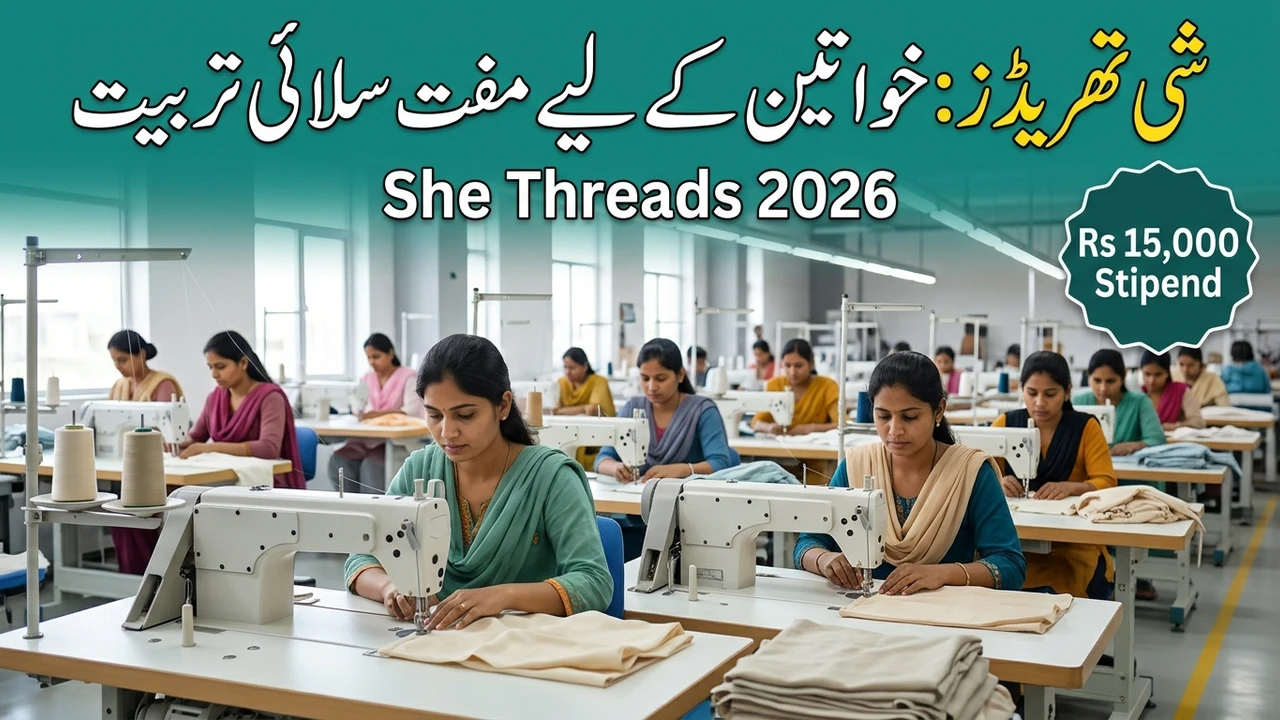
The Punjab She Threads Program 2026 offers women in Punjab free three-month vocational training in textile and garment manufacturing, along with a monthly stipend of Rs 15,000 during the training period. The programme is run by the Punjab Women Development Department, with the Punjab Skills Development Fund (PSDF), and it is aimed at women who want employment or self-employment in the textile sector.
In simple terms, selected trainees learn practical textile skills, receive training materials, and get a monthly stipend while they train. After the course, they receive job placement support with participating textile companies. Registration is in person at a participating textile factory — no online portal is claimed — so confirm the current course and eligibility details with your selected centre before visiting.
This guide explains what the programme offers, who it targets, which courses are included, where training is held, what documents to bring, and how registration works. It also explains, plainly, where different sources give different eligibility details.
Key Details
| Detail | Information |
| Programme name | Punjab She Threads Program 2026 |
| Run by | Punjab Women Development Department, with the Punjab Skills Development Fund (PSDF) |
| Training duration | 3 months, free of charge |
| Monthly stipend | Rs 15,000 during training |
| Training field | Textile and garment manufacturing |
| Training locations mentioned | Faisalabad and Lahore |
| Registration method | In person at a participating textile factory |
| Online portal | No online portal claimed |
| Documents to bring | Original CNIC and domicile certificate |
| After training | Job placement support with participating textile companies |
| Application deadline | No deadline verified — do not rely on any last date unless the centre confirms one |
Read Also: Benazir Hunarmand Program 2026
What Is the Punjab She Threads Program 2026?
The Punjab She Threads Program 2026 is a women-focused vocational training programme in textile and garment manufacturing. It is designed for women from rural and less-developed areas of Punjab who want to build a practical skill that can lead to employment or self-employment. Rather than classroom-only learning, the programme focuses on hands-on training that reflects how textile factories actually work.
Training lasts three months and is free. During that period, trainees receive a monthly stipend of Rs 15,000. Training materials are provided, and transportation assistance has been announced by the government. Travel and material costs are often the hidden barriers that stop women from joining a course, even when tuition itself is free.
The programme is run by the Punjab Women Development Department, with the Punjab Skills Development Fund (PSDF) — a structured training programme connected to the textile industry, not an informal short course.
After the course, trainees receive job placement support with participating textile companies. That means help and linkage with participating companies, not a promise that every trainee will automatically receive a job. Ask the centre, during registration, what placement support looks like for your chosen course.
Read Also: Balochistan Youth Vocational Training Quetta 2026
Who Can Apply for She Threads Training in Punjab?
The programme targets women from rural and less-developed areas of Punjab who want employment or self-employment. That target group is clear. The detailed eligibility rules, however, differ across sources, and readers need to know about those differences before they visit a centre.
Official programme information says the age range is 18 to 45 years. The latest registration instructions say an applicant must be at least 18 years old and must not have previously been associated with the factory where she is applying. Earlier announcements also listed a minimum education level of Middle school.
These are not minor differences. A woman who is over 45, or who was previously associated with a particular factory, could be treated differently depending on which instruction the centre is currently following, and education requirements may also vary by centre or course.
For that reason, this guide does not present one single eligibility rule as settled. Confirm the eligibility that applies to you with your selected centre before visiting, including age, education, prior association with the factory, and current seat availability. That check can save a wasted journey, especially for women travelling from rural areas.
Seats are limited, and the department advises registering soon. That is not the same as a deadline: no application deadline has been verified, so this article does not give a last date. If a centre gives a date, treat it as that centre’s instruction only.
Read Also: Sindh Pink Scooty Documents Checklist 2026
What Courses Are Available Under She Threads?
The programme covers textile-related skills, with a strong focus on practical, factory-relevant roles. The courses named in programme information include Industrial Stitching Machine Operator and Apparel Supervisor, along with other textile-related skills.
Industrial Stitching Machine Operator training is suited to women who want direct, hands-on work in garment production. It focuses on operating industrial stitching machines, which is one of the core production roles in a textile factory. Apparel Supervisor training, by contrast, points toward a supervisory role, with responsibility for overseeing production work and supporting a team on the factory floor.
Course availability at each centre may differ, so confirm which courses currently have seats before visiting. A course that was open earlier may fill up, and a centre may update its available courses.
When choosing, think about your longer-term goal. A stitching operator course builds a direct production skill for a factory job or home-based stitching work. A supervisor course builds toward coordination and oversight, and may suit women with some production experience. Base the choice on the centre’s current offer, not on an assumption that every course is open at every centre.
What Benefits Do Trainees Receive During the 3-Month Training?
The most widely noted benefit is the monthly stipend of Rs 15,000 during training. For many households, that stipend makes a three-month course possible, because it helps cover the time and costs of attending regularly. Confirm with the centre how the stipend is paid and whether regular attendance is linked to it.
Training materials are provided, so trainees are not expected to buy their own basic materials. Transportation assistance has also been announced by the government. This article does not state a transport amount, because no verified amount is available for this guide — ask the centre what transport assistance, if any, applies to your course and location.
Training includes practical experience with industrial equipment, textile production processes, workplace communication, teamwork, and digital financial literacy. Equipment experience prepares trainees for real factory conditions, production knowledge shows how a garment moves from stage to stage, communication and teamwork prepare them for the production floor, and digital financial literacy helps them manage earnings and use digital payment tools safely.
Read Also: Benazir Hunarmand Program 2026
Where Is the Training Held in Punjab?
Training is held at participating textile factories. Registration information names two centres, one in Faisalabad and one in Lahore. Choose the centre you can reach regularly for three months, not only the nearest one on a map, because daily travel for three months is a real commitment.
The centres named are:
| Centre | Location | Course named for the centre |
| Masood Textile Mills, Faisalabad | 32 KM, Sheikhupura–Faisalabad Road, Faisalabad | Industrial Stitching Machine Operator |
| Shahkam Industries (Pvt.) Ltd., Lahore | 1 KM Defence Road, 23 KM off Multan Road, Lahore | Apparel Supervisor |
Earlier programme information also listed Industrial Stitching Machine Operator at Shahkam Industries; confirm this with the Lahore centre before visiting, as availability may change.
Before travelling, confirm three things with your chosen centre: whether your course currently has seats, what eligibility rule it is applying, and when registration is open.
Read Also: Balochistan Youth Vocational Training Quetta 2026
She Threads Program Mein Khawateen Register Kaise Kar Sakti Hain?
Registration for the Punjab She Threads Program 2026 is in person at a participating textile factory. No online portal is claimed for this programme, so women should not search for an online application link or submit personal details through an unverified website claiming to register them.
The registration steps are:
- Choose a centre and a course. Decide between Masood Textile Mills in Faisalabad and Shahkam Industries in Lahore, based on which location you can reach regularly and which course you want. Confirm with the centre that the course currently has seats.
- Confirm your eligibility with that centre. Ask about the age rule, any education requirement, and the rule about prior association with the factory. Eligibility details differ across sources, so the centre’s current instruction is the one that matters for your application.
- Prepare your documents. Bring your original CNIC and your domicile certificate. Do not bring photocopies only if originals are required, and keep your documents safe during travel.
- Visit the centre in person. Go to the participating textile factory you selected and complete the registration process there, following the centre’s instructions on the day.
- Ask about the next steps before leaving. Confirm the training start arrangements, the stipend process, any transport assistance that applies, and what job placement support is offered after the course. Note down the name of the person or office that gave you the information, if possible.
- Do not pay anyone for registration. Training is free. If anyone asks for a fee to secure a seat or speed up registration, treat that as a warning sign and do not pay. Verify the matter with the centre directly.
Women travelling from rural or less-developed areas should plan carefully: travel early where possible, and, where family support is available, travel with a family member for the first visit. It is also a good time to see the factory setting and ask about daily timings and attendance.
Read Also: Sindh Pink Scooty Documents Checklist 2026
What Documents Do Women Need to Bring for Registration?
Only two documents are named in the registration information for this programme: the original CNIC and the domicile certificate. That short list makes preparation simpler, but it also makes it more important to bring the correct originals.
Your CNIC confirms your identity and age, which matters where an age rule applies. Your domicile certificate confirms your domicile, which matters for a programme targeted at women from Punjab, including rural and less-developed areas. Bringing both originals avoids the risk of being turned away for incomplete documents.
Before visiting, check that your CNIC is valid and your domicile certificate is available and in good condition. If either is missing or damaged, deal with that first where possible, rather than discovering the problem at the centre. Keep both documents in a safe folder, and do not hand your original CNIC to strangers or agents outside the centre.
How Can Applicants Stay Safe From Fraud While Registering?
Because this is a free government-linked training programme with a monthly stipend, it can attract false claims. Women should be cautious about anyone who promises a guaranteed seat, a guaranteed job, or faster registration in exchange for money or personal information.
Training under this programme is free. Never pay agents for registration. No agent can legitimately charge a fee to secure a place in a free programme, and a payment demand is a strong reason to stop and verify the claim with the centre itself.
Verify details with the centre before acting on social media posts, forwarded messages, or unofficial pages. Course availability, eligibility rules, and registration timings can change, and only the centre can confirm its current position. If a message claims a deadline, a seat count, or an online link this guide does not verify, treat it as unverified until the centre confirms it.
Do not share your OTP, bank details, mobile banking passwords, or CNIC copies with strangers who contact you about this programme. A genuine factory-centre registration does not require you to share banking passwords or one-time codes by phone or message. If someone pressures you to share them quickly, end the contact and check with the centre.
If something feels wrong, pause. A legitimate opportunity will still be there after you verify it; a fraud attempt often relies on urgency, secrecy, or a demand for immediate payment.
Read Also: Benazir Hunarmand Program 2026
What Questions Do Women Most Often Ask About She Threads?
Is the Punjab She Threads Program 2026 really free?
Yes. Trainees also receive Rs 15,000 per month during the three-month training period, and training materials are provided. Never pay an agent for registration.
How long does the training last?
The training lasts three months. It covers textile and garment manufacturing skills, including practical experience with industrial equipment and textile production processes, along with workplace communication, teamwork, and digital financial literacy.
How much is the monthly stipend?
The monthly stipend is Rs 15,000 during training. Confirm with your centre how it is paid and whether regular attendance is linked to it.
Who is the programme for?
The programme targets women from rural and less-developed areas of Punjab who want employment or self-employment. Eligibility details differ across sources, so confirm the rule that applies to you with your selected centre before visiting.
What is the age limit for She Threads?
This is one area where sources differ. Official programme information says 18 to 45 years, while the latest registration instructions say at least 18 and that the applicant must not have previously been associated with the factory where she is applying. Confirm the current rule with your centre before travelling.
Is there a minimum education requirement?
Earlier announcements also listed minimum education of Middle school. Because eligibility details differ across sources, confirm with your selected centre whether an education requirement currently applies to your chosen course.
Can I apply online for She Threads?
No online portal is claimed for this programme. Registration is in person at a participating textile factory. Do not submit personal details through an unverified website claiming to offer online registration.
Is there a last date to apply?
No application deadline has been verified, so this guide does not give a last date. Seats are limited and the department advises registering soon, but readers should confirm any date given by their centre directly with that centre, rather than relying on a date seen elsewhere.
Will I definitely get a job after the course?
No guaranteed job is claimed. After the course, trainees receive job placement support with participating textile companies — ask your centre what that support includes for your course.
Read Also: Balochistan Youth Vocational Training Quetta 2026
Final Words
The Punjab She Threads Program 2026 is a practical opportunity for women in Punjab who want a textile skill, a stipend while they learn, and support towards work afterwards. Free three-month training, a Rs 15,000 monthly stipend, training materials, announced transportation assistance, and job placement support with participating textile companies together make it a programme worth considering seriously.
The most important step is also the simplest: confirm before you travel — which course currently has seats, which eligibility rule applies to you, and what the registration arrangements are. Eligibility details differ across sources, course availability may differ by centre, and no deadline has been verified, so a quick confirmation can save time and avoid disappointment.
Women who meet their centre’s current requirements and can attend regularly for three months should consider visiting soon, while seats remain available. Take your original CNIC and domicile certificate, do not pay anyone for registration, and do not share OTP or bank details with strangers.
Disclaimer: amuoba.pk is NOT an official website and is not affiliated with the Punjab government, the Punjab Women Development Department, or the Punjab Skills Development Fund (PSDF). This article is for information only. Programme details, eligibility rules, course availability, and registration arrangements may change, so readers should confirm all details with their selected training centre before visiting or making any decision.




1 thought on “Punjab She Threads Program 2026: Rs 15,000 Monthly Stipend for Women in Textile Training”