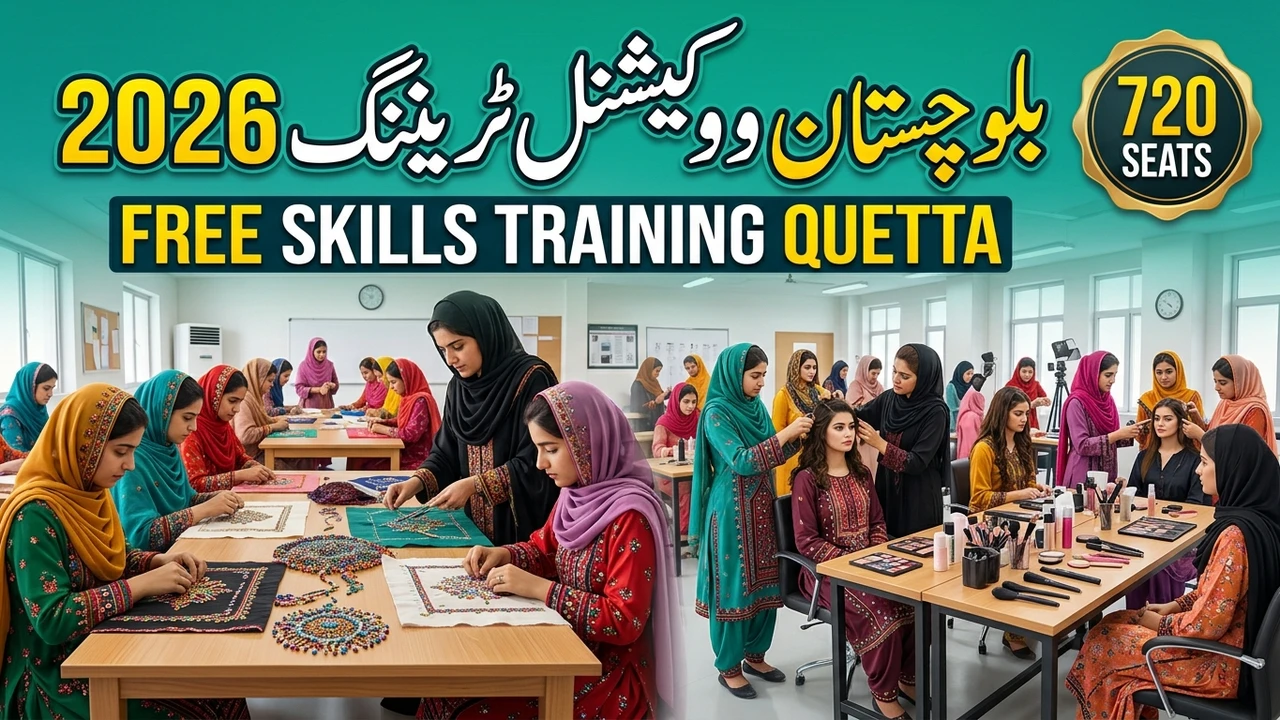
The Balochistan government has launched the Youth Vocational Skills Training Programme in Quetta, with a target of training more than 720 young people in the city. More than 240 female students are already enrolled, and current courses include beauty services, hand embroidery and other vocational trades. The training is practical and hands-on, aligned with modern industry requirements, with a particular focus on women and women’s economic independence. The aim is jobs, self-employment, or a small business after training, helping to reduce unemployment and promote entrepreneurship across Balochistan.
This is not a degree course, and it is not a promise of a government job. It is vocational training — learning by doing — in trades people pay for every day, from beauty services in a salon to hand embroidery sold in local markets and online. That practical focus is why families in Quetta are paying attention, and why the enrolment of more than 240 female students matters. It shows young women are ready to learn and earn when a genuine opportunity reaches them.
This guide covers only verified facts, plus the important gaps: no online portal, last date, stipend, age limit, or course duration was confirmed for this programme in the sources checked, and we will not invent them.
Read Also: Benazir Hunarmand Program 2026: Free Skill Training That Can Change a BISP Family’s Income
Key Details at a Glance
| Programme | Youth Vocational Skills Training Programme |
| Launched By | Balochistan Government |
| Location | Quetta, Balochistan |
| Training Target | More than 720 young people in Quetta |
| Female Students Enrolled | More than 240 |
| Current Courses | Beauty services, hand embroidery and other vocational trades |
| Training Style | Practical, hands-on, aligned with modern industry requirements |
| Special Focus | Women and women’s economic independence |
| Main Goal | Jobs, self-employment, or small business after training |
| Wider Aim | Reducing unemployment and promoting entrepreneurship across Balochistan |
| Portal / Last Date / Stipend / Age Limit / Duration | Not confirmed in the opened sources for this programme |
If a detail is not listed above as verified, treat any other website claiming it for this programme with caution until a provincial government announcement confirms it.
Read Also: CM Punjab Honhaar Scholarship Phase 4 2026: Apply Before 9 November for 100% Tuition Fees
What Is the Balochistan Youth Vocational Skills Training Programme?
The Youth Vocational Skills Training Programme is a provincial initiative in Quetta to give young people job-ready skills. Instead of only classroom theory, it focuses on trades you learn by practising until you can do the work to a professional standard. That matters in Balochistan, where many young people finish schooling but struggle to find work because employers want experience, not just certificates. A young woman who can professionally provide beauty services, or produce high-quality hand embroidery, has something she can sell immediately, whether she joins a salon, works from home, or starts her own small setup.
The target is more than 720 young people in Quetta. That is a Quetta target, not a province-wide total, and it does not mean every district has the same intake at this stage. It means a focused, city-level effort where training, trainers, and learners can be brought together properly.
The focus on women is central: more than 240 female students are already enrolled. Even a modest, steady income from home-based work can pay for children’s schooling, cover household expenses, and give a young woman confidence and independence. Teaching beauty and embroidery to current standards of hygiene, finishing, and customer care also avoids the old problem of outdated skills that no customer wants.
Read Also: Benazir Hunarmand Program 2026: Free Skill Training That Can Change a BISP Family’s Income
Who Can Benefit Most From This Training?
This programme is most useful for young people in Quetta who want a practical route into earning, especially those not heading towards a university degree right now, or who want a skill alongside their studies. It is particularly relevant for young women who want to work from home, start a small beauty or embroidery setup, or join a salon or workshop with real skills rather than as an untrained helper. It can also help school and college leavers unsure about their next step, unemployed youth who need a first income, and anyone with a basic interest in beauty, stitching, or embroidery who wants to turn it into professional work.
A certificate alone does not create income; consistent practice, good finishing, honest pricing, and reliable customer service do. The programme’s aim — jobs, self-employment, or small business after training — reflects that reality.
Families should think practically before enrolling: beauty services suit people who enjoy working with customers face to face, while hand embroidery suits people with patience, fine handwork, and an eye for design, and it can often be done from home. Choosing a trade you actually enjoy makes it far more likely you will finish the course and keep practising afterwards.
Which Courses Are Currently Included?
Current courses include beauty services, hand embroidery and other vocational trades. Beauty services cover professional salon work customers in Quetta use regularly — grooming, skincare basics, and hair and makeup-related services taught to a professional standard, with attention to hygiene, products, and customer care. Taught properly, this is about running a service safely, cleanly, and consistently, so customers return and recommend you to others.
Hand embroidery is equally valuable and carries special cultural and economic importance in Pakistan. Skilled embroidery is used in clothes, home textiles, and fashion items, and it can be sold piece by piece. A learner who masters neat, durable, and attractive embroidery can take orders from home, work with local shops, or sell through family and community networks.
The phrase “other vocational trades” means the local list may be broader, but we have not listed extra trades because they were not specifically confirmed in the opened sources. Check the exact trade list at your local Quetta training centre, rather than assuming a trade is offered because another scheme elsewhere offers it.
Read Also: CM Punjab Honhaar Scholarship Phase 4 2026: Apply Before 9 November for 100% Tuition Fees
Quetta Ki Khawateen Ke Liye Ye Training Kyun Ahem Hai?
Quetta ki khawateen ke liye ye training sirf aik course nahi, balkay aik moqa hai apni mehnat ko aik pehchan aur aik mustaqil aamdani mein badalne ka. Aksar khawateen ke paas hunar hota hai, lekin usay professional tareeqay se seekhne aur customers tak pohanchane ka tareeqa nahi hota. Ye programme isi kami ko poora karta hai — practical training ke zariye, jahan seekhna haath se kaam karke hota hai. Jab aik khatoon beauty services ya hand embroidery mein mahir ho jati hai, to wo ghar se kaam shuru kar sakti hai aur ahista ahista apna chhota business bana sakti hai. Is ka markaz khawateen ki maashi khudmukhtari hai, aur Quetta mein 240 se zyada female students ka enrolled hona is baat ka saboot hai ke khawateen is moqay ko sanjeedgi se le rahi hain. Pehle apni dilchaspi samjhein, phir training centre se maloomat lein, aur kisi agent ko fees dekar seat ka wada na lein.
How Does Practical Training Lead to Jobs or Self-Employment?
An employer hiring for a salon does not only ask what you studied; they ask to see your work, watch how you handle a customer, and check whether your finishing is neat and hygienic. A customer ordering embroidery looks at the stitching, design, fabric, and whether work was delivered on time. That is why practical training aligned with modern industry requirements matters: it closes the gap between “I have learned about this” and “I can do this well enough to be paid for it.”
After training, there are three main paths. The first is a job in a salon, workshop, or shop. The second is self-employment, offering services directly to customers and building a client list through good work and word of mouth. The third is a small business, starting with one service, saving earnings, and gradually growing. None is instant or guaranteed by enrolment alone. Training gives a fair start; continued practice, professionalism, and patience turn that start into income. Keep a simple portfolio from day one — photos of finished embroidery and beauty work, with customer permission — because in trades, your work speaks louder than any brochure.
What Is Not Confirmed Yet — Please Read This Carefully
Honesty matters more than a complete-looking article, so here are the caveats plainly:
First, do NOT claim an online application portal, a last date, a stipend, an age limit, or a course duration for this programme — none of these were confirmed in the opened sources for THIS programme. Other Balochistan training schemes may have their own portals, dates, and rules, but those details must not be imported into this programme. Any article listing them for this programme without a provincial announcement should be treated as unverified.
Second, do NOT claim “Apply Online @bsdp.pk” for this programme. That address was not verified in the opened sources, and we are not presenting it as the application route. Do not send personal documents, CNIC copies, or fees to any website or person claiming to be the official portal until a provincial government or B-TEVTA announcement confirms the correct route.
Third, the 720 figure is a Quetta target, not a province-wide total. It refers to more than 720 young people to be trained in Quetta, not 720 seats for all of Balochistan or for every district. Instead, check provincial and B-TEVTA announcements and local training centres in Quetta for enrolment details, trades currently open, seats remaining, documents required, and when the next batch begins. Official announcements are the final authority.
Read Also: Benazir Hunarmand Program 2026: Free Skill Training That Can Change a BISP Family’s Income
How Can Interested Learners Check Enrolment Safely?
Since no verified online portal has been confirmed, follow these steps:
- Start with provincial government and B-TEVTA announcements, not social media forwards, and look for a notice naming this exact programme in Quetta with a centre name and contact point.
- Visit or contact a local training centre in Quetta and ask which trades are open, how many seats are available, and what the enrolment process actually is there.
- Ask in writing, where possible, what documents are required, whether there is any fee, and what the schedule will be, and note who gave you the information.
- Do not pay any agent, middleman, or social media page for a seat, a form, or faster admission. Genuine enrolment does not require paying an agent for a guaranteed place.
- Do not share your CNIC copy, OTP, bank details, or passwords with anyone claiming to register you online. No legitimate process asks for an OTP or bank login.
- If someone promises a guaranteed seat, stipend, or job after payment, verify through the centre itself before taking any further step.
- Once details are verified, complete only the process the centre confirms, keep your receipt safe, and attend regularly.
How to Stay Safe From Fraud Around Training Programmes?
Fraud usually follows the same pattern: a social media post or WhatsApp message promises easy admission, a stipend, or a job, then asks for a fee, a CNIC copy, or an OTP to “confirm” your seat. Real government programmes do not work this way. For BISP and 8171 topics, only 8171, official portals, and the helpline 0800-26477 should be trusted — never agents, never OTP sharing, never payment for registration. The same caution applies here: trust only provincial announcements and the training centre, never pay agents, and never share OTPs or bank details.
Watch out for websites copying an official design with a slightly different address, Facebook pages using government logos without a verified official announcement, and individuals claiming to be “inside” the programme who can reserve seats for a fee. If unsure, take a screenshot, show it at the training centre, and ask whether it is genuine. It is always better to ask one extra question than to lose money or personal documents. Warn young learners, especially young women enrolling for the first time, that no one should pressure them to pay quickly or share documents privately to secure a place.
Read Also: CM Punjab Honhaar Scholarship Phase 4 2026: Apply Before 9 November for 100% Tuition Fees
Frequently Asked Questions
Q: What is the Balochistan Youth Vocational Skills Training Programme?
A: It is a Balochistan government programme in Quetta teaching practical vocational trades, with a focus on women and economic independence, so learners can move towards jobs, self-employment, or small business.
Q: How many young people will be trained in Quetta?
A: More than 720 young people in Quetta. This is a Quetta target, not a province-wide total, and not seats for every district.
Q: How many female students are already enrolled?
A: More than 240 female students are already enrolled, showing strong early interest from young women in Quetta.
Q: Which courses are currently included?
A: Beauty services, hand embroidery and other vocational trades. Confirm the exact local list at your Quetta training centre, as extra trades were not specifically confirmed in the opened sources.
Q: Is there an online application portal for this programme?
A: No online portal was confirmed in the opened sources for this programme. Do not treat “Apply Online @bsdp.pk” as verified, as that address was not verified in the opened sources. Check provincial/B-TEVTA announcements and local Quetta centres instead.
Q: What is the last date, stipend, age limit, or course duration?
A: None were confirmed in the opened sources for this programme, so this article does not state them. Check any such claim against an official provincial announcement first.
Q: Will training guarantee a job?
A: No. Training prepares learners for jobs, self-employment, or small business, but employment depends on skill, practice, professionalism, and local opportunities.
Q: Can women work from home after beauty or embroidery training?
A: Yes, in many cases. Both trades can be offered from home on a small scale. Success depends on quality, hygiene, fair pricing, reliability, and customer trust built over time.
Q: How can I avoid fraud while applying?
A: Use only provincial announcements and the training centre, never pay an agent for a seat, never share OTPs or bank details, and verify any promise of a guaranteed seat or stipend at the centre first.
Final Words
The Balochistan Youth Vocational Skills Training Programme in Quetta is an encouraging step: more than 720 young people targeted in one city, more than 240 female students already enrolled, and courses in beauty services, hand embroidery and other trades that people actually need and pay for. Its focus on practical skills, modern standards, and women’s economic independence gives it a real chance to change lives — not through promises, but through work learners can do, show, and sell.
Follow it the responsible way: do not chase unverified portals or deadlines, do not pay agents, and do not assume details from other schemes apply here. Visit a local training centre in Quetta, ask clear questions, keep your documents safe, and choose a trade you will practise seriously. Done carefully, this programme can be the first step towards an income, a small business, and greater independence.
Read Also: Benazir Hunarmand Program 2026: Free Skill Training That Can Change a BISP Family’s Income
Disclaimer: amuoba.pk is NOT an official website. This article is for information only, based on reports published on 26 October 2026 and checked on 31 October 2026. Provincial government and B-TEVTA announcements are the final authority for this programme, including enrolment, trades, seats, and any future dates or requirements. Always verify details with the relevant training centre in Quetta before applying, paying any fee, or sharing personal documents.