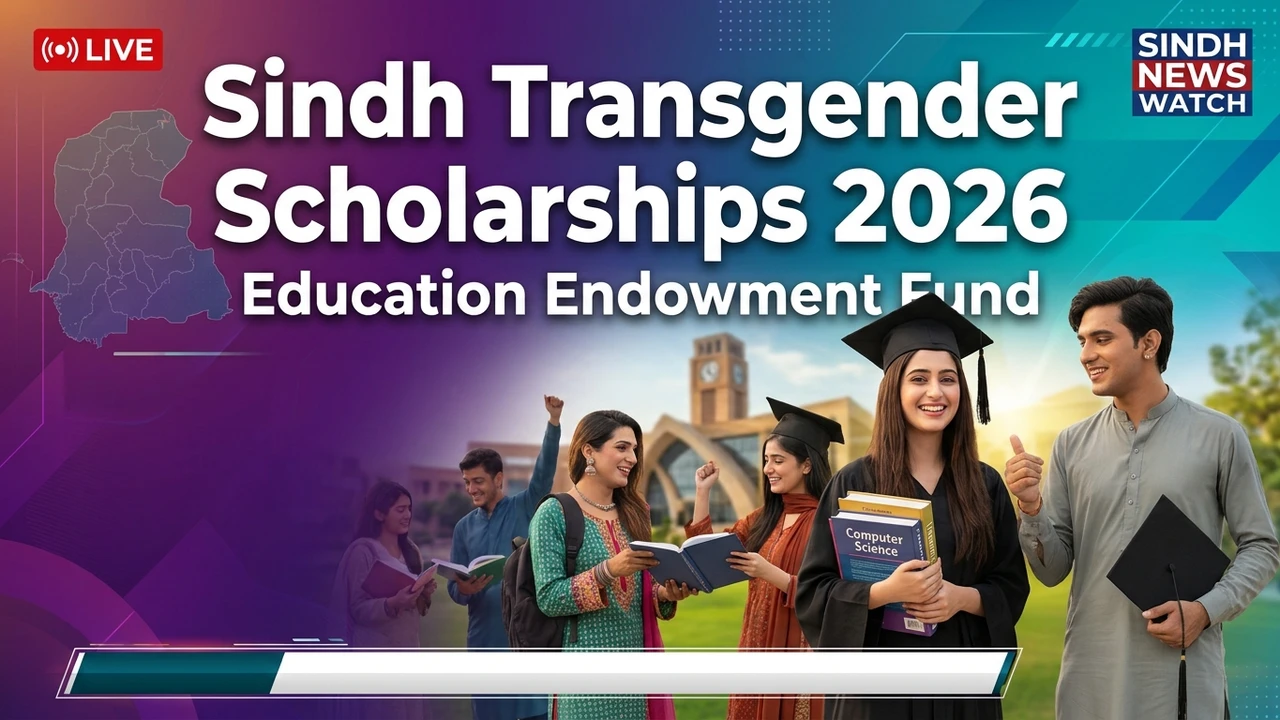
The Sindh government has decided to offer higher-education scholarships to transgender students through the Sindh Education Endowment Fund (SEEF). The decision was taken in Karachi on November 5, 2026, at a meeting between Education Minister Syed Sardar Ali Shah and a transgender community delegation.
It matters for a community long shut out of education, from admission forms with no suitable gender option to attitudes that pushed students out. The government has also promised a comprehensive transgender education policy, finalised with community input.
One thing is clear: the decision is announced, but the detailed rules are not yet published. No deadline, seat count or stipend amount has been confirmed. This article covers everything officially confirmed so far, how the Fund normally works, and what to do now.
Key Details
| Detail | Confirmed Information |
| Announcement | Scholarships for transgender students seeking higher education |
| Announced on | November 5, 2026, in Karachi |
| Announced by | Education Minister Syed Sardar Ali Shah |
| Scholarship route | Sindh Education Endowment Fund (SEEF) |
| Level of study | Higher education (university level) |
| Policy | Transgender education policy to be finalised with community input |
| Deadline / seats / amount | Not announced yet |
| Official source | seef.sindh.gov.pk; College Education Department, Sindh |
Read Also: Punjab She Threads Program 2026: Rs 15,000 Monthly Stipend for Women in Textile Training
What Did the Sindh Government Announce?
Transgender students seeking higher education will be supported through the Sindh Education Endowment Fund. The decision came at a meeting between Education Minister Syed Sardar Ali Shah and a community delegation that discussed the barriers transgender individuals face in accessing education.
The delegation included Shahzadi Rai, a KMC City Councillor and Sindh’s focal person for the transgender community, with Zahrish Khanzadi and Miss Kami Chaudhry. The minister agreed the policy draft would be finalised only after consultation with community representatives, who would also take part in approving it — giving them a direct say in decisions about their education and future.
The minister also noted that Sindh’s recruitment policy already includes a job quota for the transgender community, and that transgender individuals could serve as teachers once qualified — so the scholarship is a first step toward a profession and a secure livelihood.
Read Also: Punjab 1 Million Youth Skills Training 2026: New Centres, Language Courses & Who Benefits
Who Can Apply for the Scholarship?
The exact eligibility rules have not been published yet, because the policy is still being finalised. What is confirmed is that the scholarships are for transgender students in Sindh seeking higher education; the rest will be announced with the policy and guidelines.
Until then, the Fund’s published criteria for other students are the best guide:
- Sindh domicile: Applicants must hold a domicile and permanent residence certificate of Sindh.
- Enrolment: Applicants must be regular, full-time students in a graduate or postgraduate programme at an institution approved by SEEF.
- Merit and need: Scholarships go to deserving, meritorious and needy students.
- Family income: SEEF assesses family income in three groups, favouring the lowest incomes. Applicants need proof of income, such as an FBR tax return, a salary slip or a bank statement.
- Approved institutions: Only students at SEEF-panel universities and institutions are eligible — 92 across Pakistan.
- Eligible fields: SEEF supports medicine, dentistry, veterinary medicine, physiotherapy, engineering, agricultural engineering, pharmacy, law, education, social sciences, and business and computer-related degrees.
Distance learning, self-financing and part-time students, and students at affiliated colleges, are not eligible under the Fund’s general rules. Whether the same exclusions apply to the new track will only be clear when the official guidelines are published.
Read Also: Benazir Hunarmand Program 2026: Free Skill Training That Can Change a BISP Family’s Income
What Will the Scholarship Cover?
The exact coverage has not been announced yet. What is known is how the Fund normally works: it covers the full tuition fee for one academic year, paid through the student’s institution, and grants are renewed by the SEEF Board of Trustees only if the student stays eligible.
The new scholarships will probably follow the same model, but this is unconfirmed, and no stipend or hostel support has been announced. Any monthly amount quoted on social media or WhatsApp is unverified until SEEF publishes it.
Running since 2002, the Fund has supported more than 42,700 students with over Rs 6.9 billion at 92 institutions across Pakistan, according to the Sindh government — so transgender students are joining an established system.
Read Also: Punjab Laptop & Honhaar Scholarship 2026: 6,161 Laptops Given in Attock
How Can Transgender Students Apply?
Applications have not opened yet. There is no form, portal link or deadline yet, and anyone claiming to accept applications is not speaking for the government. Here is what to do now.
Step 1: Watch the official channels only. The genuine announcement will appear on seef.sindh.gov.pk and through the College Education Department, Government of Sindh. Ignore offers from random Facebook pages, WhatsApp groups or agents.
Step 2: Confirm your enrolment. SEEF scholarships normally go to students already enrolled full-time at a panel institution. If you are seeking admission, aim for a SEEF-panel university.
Step 3: Get your documents in order. You will most likely need your Sindh domicile and permanent residence certificate, CNIC, academic certificates and transcripts, and proof of family income such as an FBR tax return, salary slip or bank statement.
Step 4: Apply through your institution. Candidates normally apply through their own college or university. SEEF collects eligible students’ data from panel institutions and announces interview dates, and institutions contact shortlisted students for an interview. A merit list then goes to the SEEF Board of Trustees for final approval. If the new track follows the same route, your university’s administration office is your first point of contact.
Step 5: Prepare for the interview. Shortlisted candidates are interviewed before final selection, so keep your original documents ready and be prepared to explain your academic record and financial need honestly.
The general SEEF round for 2025-26 has already closed, so do not confuse old advertisements with this new announcement. The transgender track will come with its own advertisement, deadline and application process.
Read Also: Punjab She Threads Program 2026: Rs 15,000 Monthly Stipend for Women in Textile Training
Transgender Talba ke Liye Ye Scholarship Kyun Ahem Hai?
Ye scholarship sirf fees ki madad nahi, izzat aur barabari ka paigham hai. 2023 ki mardam shumari ke mutabiq Pakistan mein takreeban 20,331 transgender afraad hain, jin mein se 4,222 Sindh mein rehte hain. Aksar talba taleem se is liye mehroom reh jate hain ke un ke paas na sahoolat hoti hai, na madad aur na aisa mahaul jo unhein aage barhne de. Jab aik transgender talib ilm ko fees ki fikr se azaadi milti hai, to woh parhai par tawajjo de kar aik din ustad, doctor ya engineer ban sakta hai.
Read Also: Punjab 1 Million Youth Skills Training 2026: New Centres, Language Courses & Who Benefits
What Is the Transgender Education Policy?
The scholarships sit inside a bigger reform. Sindh has worked on a dedicated transgender education policy since 2024, when the draft of Pakistan’s first-ever such policy was approved under the same minister. It proposed a separate transgender category in admission forms, job quotas in teacher recruitment, special schools and non-formal training centres, and protection from harassment in institutions.
The government now says the policy will be finalised with community representatives, who will also help approve it. Watch for the final document: it will set out admission rules, protections against discrimination and support services.
How to Stay Safe From Scholarship Fraud
Every popular scholarship brings fake agents and scam pages within hours. Never pay anyone to apply: SEEF awards scholarships on merit and need through institutions, and no agent can secure one for a fee. Never share your OTP, CNIC copies or bank details with strangers; genuine communication comes through your institution or seef.sindh.gov.pk, never a random WhatsApp number. If an offer does not appear on the official website, treat it as unverified.
Final Words
Sindh’s decision to open the Endowment Fund to transgender students is welcome and long overdue. It recognises that talent is not limited by gender identity. The scholarships, the promised policy and the existing job quota together form a path from admission to employment.
But the announcement is only the beginning. The real test is in the details: how many scholarships are offered, how simple the process is, and whether students are treated with dignity at every step. Prepare your documents, stay in touch with your institution, and follow only official announcements.
Disclaimer: amuoba.pk is an independent news website, NOT an official government website, and is not affiliated with the Government of Sindh, the College Education Department or SEEF. Rules and deadlines may change — always confirm the latest details at seef.sindh.gov.pk before applying.
Sources: The News (Nov 6, 2026); seef.sindh.gov.pk; SEEF guidelines via International Islamic University Islamabad; Dawn (Nov 14, 2024).