
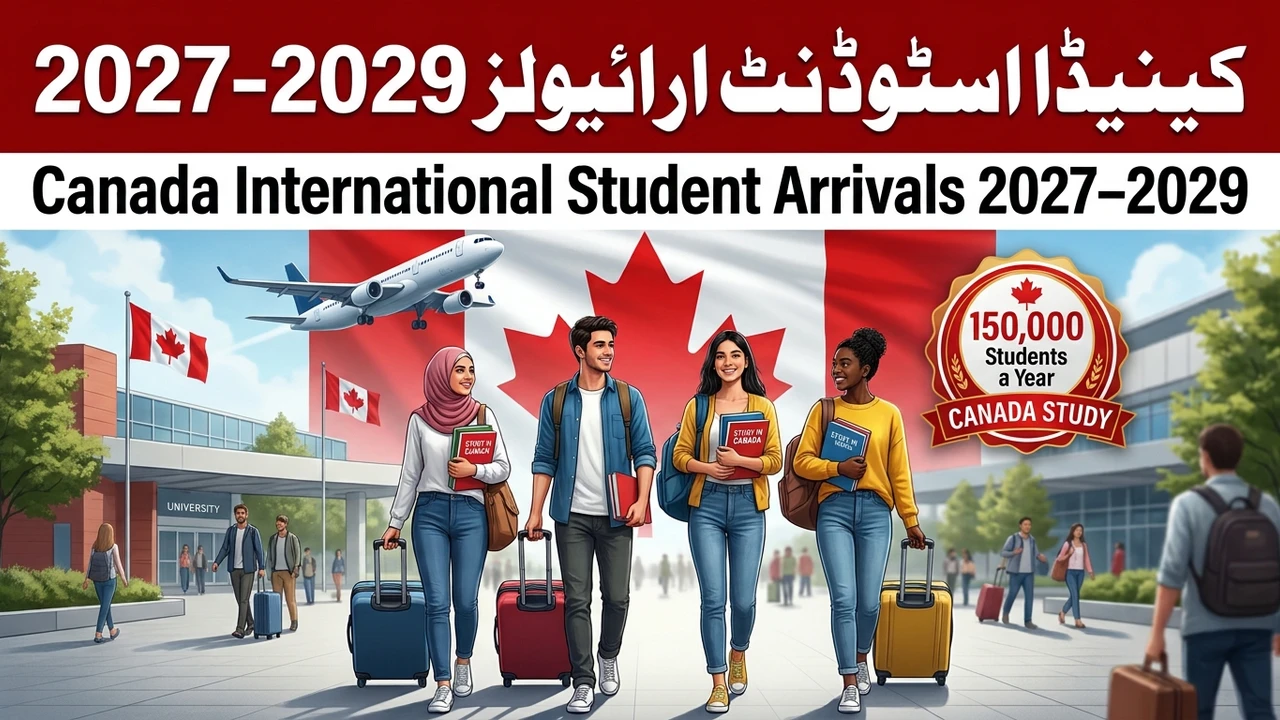
Canada will allow up to 150,000 new international student arrivals in each of 2027, 2028 and 2029 under its new Immigration Levels Plan, published on 5 November 2026 by Immigration, Refugees and Citizenship Canada (IRCC) alongside Budget 2026. It is a planning target for new arrivals, not a count of study permits to be issued, and not a guarantee of a permit or a place — and not an increase: the same figure was already set for 2027 and 2028.
Key Details
| Item | Detail |
|---|---|
| Plan | Canada’s 2027–2029 Immigration Levels Plan |
| Published | 5 November 2026, with Budget 2026 |
| Source | Immigration, Refugees and Citizenship Canada (IRCC) |
| New student arrivals | Up to 150,000 per year in 2027, 2028 and 2029 |
| 2026 student target | 155,000 |
| Total new temporary residents | 370,000 per year (220,000 workers + up to 150,000 students) |
| Range for that total | 355,000 to 385,000 per year |
| Permanent resident admissions | 380,000 per year (separate measure) |
| Economic class share of PR admissions | Above 64% |
| What the student figure counts | New arrivals only |
| What it does not count | Permit extensions; in-Canada study/work permit applications |
| Status of 2028–2029 figures | Planning figures that can be revised |
What Did Canada Announce in the 2027–2029 Immigration Levels Plan?
Canada’s Immigration Levels Plan sets how many permanent residents the country plans to admit and how many new temporary residents — workers and students — it plans to receive each year. IRCC explained the 2027–2029 plan in a backgrounder, “Building a Stronger Canada Through a Well-Managed, Predictable Immigration System.” For students it is straightforward: up to 150,000 new international student arrivals in each of 2027, 2028 and 2029, as listed in the Supplementary Information table — the same figure in all three years, held steady.
Read Also: HEC PhD Scholarships USA 2026: Fall 2027 Admissions Open
Is 150,000 Students a Year a New Increase?
No. The previous plan, covering 2026–2028, had already set the student target at 150,000 for 2027 and 2028. The new plan keeps those figures and adds the same figure for 2029: continuity, not expansion. The 2026 target was 155,000, so the move to 150,000 in 2027 is a small step down, not a rise.
What Does the 150,000 Figure Actually Count?
The figure counts new arrivals only — students arriving in Canada for the first time under the plan’s counting method. It does not include students already in Canada who extend their study permit, or people already in Canada who apply for a study or work permit from inside the country. Nor should it be read as a count of study permits to be issued: the plan sets the arrivals target, it does not promise 150,000 permits, and every application is still decided on its own merits.
Read Also: Queen’s University Canada Scholarships 2026: CAD 25,000 for Masters and PhD
How Do Students Fit Into Canada’s Total Temporary Resident Numbers?
Students are one part of a larger total: 370,000 new temporary resident arrivals per year — 220,000 workers and up to 150,000 students — within a range of 355,000 to 385,000. Permanent resident admissions sit outside this total, at 380,000 per year, with the economic class staying above 64% of admissions. A student arriving in Canada is a temporary resident on arrival; becoming a permanent resident is a separate step, and the 380,000 figure does not add extra student places.
Are the 2028 and 2029 Figures Final?
The 2028 and 2029 figures are planning figures that can be revised. In a multi-year plan, the first year is the firmest; the later years are targets confirmed or adjusted by 1 November of the preceding year, when the next levels plan is published. Applicants planning for 2028 or 2029 should check for updates when each new plan is published.
How Do the Targets Compare With Actual Student Arrivals?
Targets need to be read against what is actually happening. Only 65,240 new international student arrivals were recorded in Canada between January and August 2026 — 71% fewer than in the same period in 2024. Yet the number of students already in Canada remains large: as of 31 August 2026, there were 602,115 study-permit holders in Canada, according to IRCC data as of that date. That counts people already holding a permit, not new arrivals in a year. Canada still hosts a very large international student population, but the flow of new students has slowed sharply since 2024.
Read Also: University of Liverpool PhD Scholarship 2026-27 UK: £21,805 Stipend
Pakistani Talba Ke Liye Is Ka Kya Matlab Hai?
Pakistani students should read the plan the same way every other international applicant does: it sets no country-wise quota and names no country. Pakistan is not mentioned, and no places are set aside for Pakistani applicants, who compete in the same global pool under the same rules. What the plan gives Pakistani applicants is clarity about the overall level — up to 150,000 new arrivals a year, held steady to 2029. Chances still depend on the individual application: admission, documents, finances and eligibility. Claims presenting the figure as a guarantee, a permit count, or good news aimed specifically at Pakistan are not supported by the plan.
What Is the Separate 200,000-Person Measure in 2027?
One other measure is sometimes confused with the student target, but it is separate and not about students. In 2027, a time-limited measure will move up to 200,000 people already in Canada to permanent residence: two cohorts of 100,000 each, a workers cohort and a humanitarian cohort. It is not extra student places.
What Should Applicants Do Next?
The plan announces no new study-permit rules, fees or application steps, so applicants should not assume the process has changed.
- Read the announcement from the official source, IRCC and the Government of Canada, not summaries on social media or agent websites.
- Check the current study-permit requirements on the official IRCC website before preparing an application, and check again before submitting.
- Apply only through official channels, and keep copies of every document and confirmation.
- Be cautious of anyone promising a guaranteed permit, a reserved place or a country quota for a fee. The plan contains no such guarantee and no such quota.
- Plan around the steady figure, not an increase: with 150,000 new arrivals a year held flat to 2029, early preparation and a complete, accurate application matter more than waiting for a larger intake.
Final Words
Canada’s 2027–2029 plan sets new international student arrivals at up to 150,000 a year — a steady figure, not an increase, since the same level was already set for 2027 and 2028 and 2026 was slightly higher at 155,000. It counts new arrivals only, sits inside a total of 370,000 new temporary resident arrivals a year, and is separate from 380,000 permanent resident admissions a year. The 2028 and 2029 figures can be revised, and actual arrivals in 2026 ran well below target, with only 65,240 new student arrivals in the first eight months. For Pakistani applicants there is no country quota. The plan gives students a clear, steady number to plan around, but it guarantees no one a permit or a place.
Disclaimer: amuoba.pk is not an official website of the Government of Canada, Immigration, Refugees and Citizenship Canada (IRCC), or the Government of Pakistan. This article is an information guide based on the IRCC backgrounder and Supplementary Information table for Canada’s 2027–2029 Immigration Levels Plan, published 5 November 2026, and IRCC data as of 31 August 2026. Always confirm student arrival targets, study-permit requirements and application steps from the official Government of Canada and IRCC websites before applying.





1 thought on “Canada International Student Arrivals 2027–2029: 150,000 Students a Year Under New Immigration Plan”