
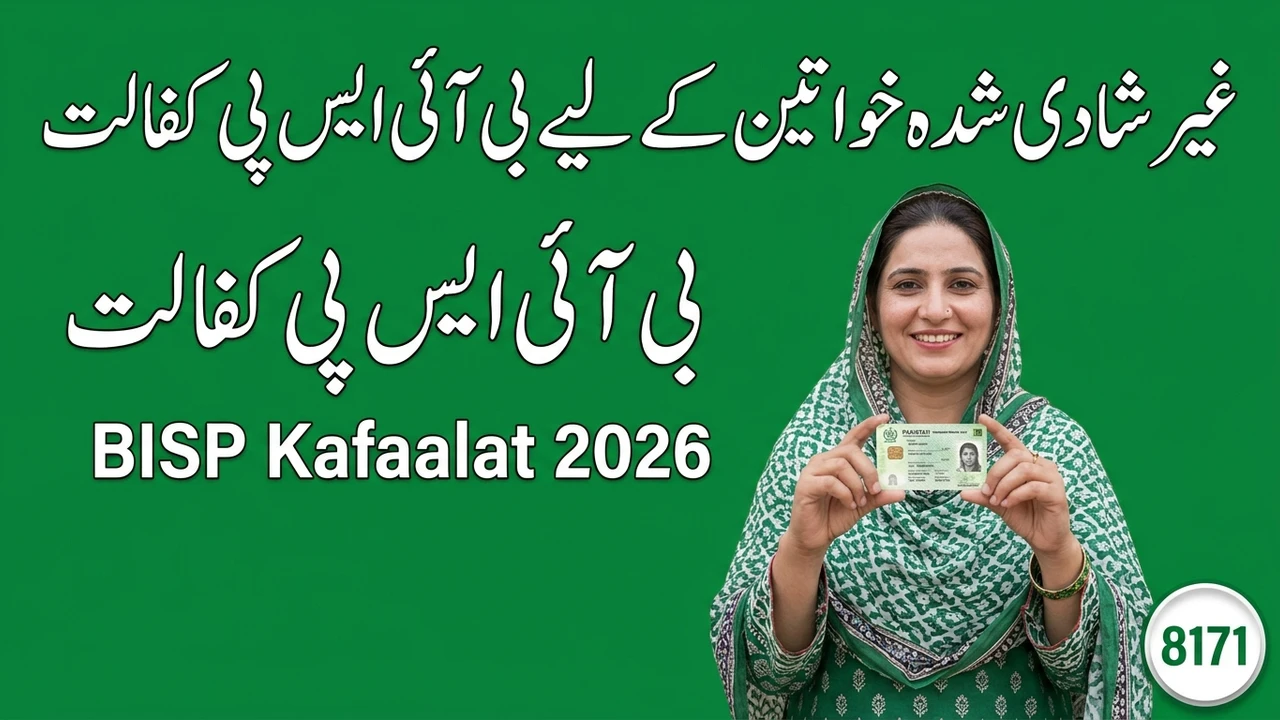
Yes — the change suggests she can. According to a Press Information Department (PID) release dated 29 October 2026, a briefing at the Benazir Income Support Programme (BISP) headquarters in Islamabad highlighted that BISP has removed the “ever-married” condition for Kafaalat payees. Under the old rule, only a woman who is or has been married could be recorded as the Kafaalat payee in an eligible household. That condition is now gone, as described in the briefing.
The distinction matters. This change is about who in an eligible household receives the money, not about who counts as poor. The household must still pass the poverty test, and the survey still decides whether a household qualifies. What has changed is that married status no longer decides which woman in the family is named as the payee.
That matters most for a poor household headed by an unmarried adult woman with no married woman in the family — a daughter caring for elderly parents, or an orphaned elder sister raising younger siblings. Such a household could be poor enough yet still have no married woman to name as payee.
Honesty matters too. BISP has not yet published the rule change itself on bisp.gov.pk; as of 31 October 2026, the newest item on its 2026 press-release list was dated 14 September 2026. No effective date, no new wording, and no process for existing households has been published yet. This article therefore tells you exactly what the briefing said, what it did not say, what has not changed, and what to do now — without claiming that an unmarried woman can already collect money today.
Read Also: BISP 8171 October Payment 2026
Key Details
| Detail | What We Know |
|---|---|
| Announcement date | 29 October 2026, via a PID release |
| Where it happened | BISP headquarters, Islamabad |
| Who was briefed | First Lady Bibi Asifa Bhutto Zardari |
| Who gave the briefing | Chairperson Senator Rubina Khalid and Secretary Amer Ali Ahmad |
| What changed | The “ever-married” condition for Kafaalat payees has been removed |
| Old rule | Only a woman who is or has been married could be the Kafaalat payee |
| Poverty test | Unchanged — PMT score of 32 or less, or 37 where a family member has a disability |
| What decides eligibility | The household survey, not married status |
| Quarterly Kafaalat amount | Widely reported at Rs 14,500; the 29 October release did not mention any amount change |
| Official BISP publication | Not yet published on bisp.gov.pk as of 31 October 2026 |
| Effective date and process | Not yet published |
What Exactly Did BISP Change in the Kafaalat Payee Rule?
Kafaalat has always paid its cash assistance to the woman of the household, so support reaches spending on food, health, and children. The old rule added a further condition — the woman named as payee had to be “ever-married,” meaning currently married, widowed, or divorced.
The 29 October 2026 briefing highlighted that this condition has been removed. In plain terms, married status no longer decides who receives the money: in a qualifying household, the payee can now be an unmarried adult woman.
What the change is not matters too: it is not a new programme or payment, creates no separate category for unmarried women, and does not change the amount. It changes one rule inside Kafaalat: who can be recorded as payee.
Read Also: 8171 PMT Score Check 2026 by CNIC
Who May Benefit Most From the Removal of the Ever-Married Condition?
The households likely to gain most are those where an unmarried adult woman is effectively heading a poor household and there is no married woman in the family. Two examples make the point.
The first is a daughter caring for elderly parents. If the household is poor enough to qualify, the old rule could still leave the family without an obvious payee, because the daughter herself had never married. Under the new position, she herself could be the payee.
The second is an orphaned elder sister who has become carer for younger brothers and sisters. Again, the household may be genuinely poor, but the old payee rule did not fit the family’s reality.
Do not overstate this. An unmarried woman in a household that is not poor enough under the survey will not qualify simply because she is unmarried, and a household that already has a married woman recorded as payee does not automatically need to change anything. The benefit is targeted: it opens the door for households previously stuck on this one specific rule. Because the practical process has not yet been published, turning the briefing into money in hand depends on how quickly BISP sends written instructions to its offices.
What Has Not Changed About BISP Kafaalat Eligibility?
The poverty test has not changed, and that deserves to be stated plainly.
A household still needs a Proxy Means Test (PMT) score of 32 or less to qualify for Kafaalat, or 37 where a family member has a disability. The PMT score comes from the household survey of living conditions, assets, and income. That survey decides who is poor enough. Married status only ever decided who in the family receives the money — and now it does not even decide that.
So nothing in the briefing suggests the door has opened to every unmarried woman, that the survey has been relaxed, or that new households can skip the survey. A household must still be surveyed and fall within the PMT threshold. If your household has not been surveyed, or its PMT score is above the threshold, the removal of the condition does not change that outcome.
The payment amount needs a careful note too. The amount widely reported for Kafaalat is Rs 14,500 per quarter, but the 29 October 2026 release did not mention any amount change, and this article does not present Rs 14,500 as confirmed in that release. Treat any claim of a new amount linked to this briefing with caution unless BISP itself publishes it. In short: same poverty test, same survey, same programme — only the payee rule has changed.
Read Also: Benazir Hunarmand Programme 2026
What Else Was Covered in the 29 October 2026 BISP Briefing?
The ever-married condition was only one part of the briefing given to First Lady Bibi Asifa Bhutto Zardari. The same briefing covered digital payments and skills training, and those figures matter because they affect how beneficiaries actually receive and use support.
On digital payments, the briefing reported 9.7 million Benazir SIMs active under the Social Protection Wallet, and 9.3 million beneficiaries who have transacted through CNIC-linked wallets, using a fingerprint check plus a second verification step. The gap between the two figures is around 400,000. That gap is simple arithmetic from the two briefing figures, not an official figure of its own, and it does not mean 400,000 people have lost money. Some beneficiaries may simply not have withdrawn yet, while others may have a SIM problem to sort out. If you hold a Benazir SIM and have not transacted, check it is active and your biometric verification works.
On skills training, the briefing reported more than 50,000 people registered for the Benazir Hunarmand Programme, covering information technology, healthcare, hospitality, and construction. In Sindh, more than 5,000 people have been trained with provincial government help, and more than 1,200 have found jobs. Those are early results, not a job guarantee.
Ghair Shadi Shuda Khawateen Ab Kya Karein?
If you are an unmarried adult woman heading a poor household, or helping such a woman in your family, follow this careful sequence now. These steps do not promise money today.
- Check your household’s status first. Visit the 8171 portal at 8171.bisp.gov.pk or send your CNIC number by SMS to 8171.
- If your household is not shown as eligible, ask about the survey. Visit your nearest BISP tehsil office and ask whether your household’s survey can be done or updated. Without the survey, the payee question does not arise.
- Take the right documents. Carry your own original CNIC, plus the CNICs of other adult household members and the B-Forms of children in the household.
- Ask the payee question directly. Ask the officer, in plain words, whether an unmarried woman can now be recorded as the Kafaalat payee for your household, following the removal of the ever-married condition announced in the 29 October 2026 briefing.
- Keep proof of your visit. Keep any token or slip you are given, and note the date of your visit and the name of the officer you spoke to. If you are told there are no instructions yet, that note is useful for a follow-up visit.
- Follow up rather than giving up. If the office says it has no instructions yet, ask when to return and check again later. Do not pay anyone to speed this up; BISP survey and registration are free.
Do not claim the money is certain, and do not let anyone charge a fee for “registering” you. The change suggests an unmarried woman can be payee once applied, but until BISP publishes its process, the honest position is that the practical route is still taking shape.
Read Also: BISP 8171 October Payment 2026
What Is Still Unclear About the Ever-Married Rule Change?
A responsible article must say what is not yet known, and here the list is significant.
First, there is no published effective date or new wording, so different offices may act — and interpret the rule — at different speeds.
Second, there is no published process for existing households. It is unknown whether already-surveyed households will be updated automatically, or whether the unmarried woman must visit an office to have the payee record changed. Families already surveyed should not assume the change has been applied to their record; checking at the tehsil office is safer.
Third, it is unknown whether the change covers other BISP programmes. The briefing spoke about the Kafaalat payee. It is not yet clear whether it applies to Taleemi Wazaif or Nashonuma. Do not assume a Kafaalat change changes every BISP programme.
Fourth, tehsil offices may still be working from old forms. Until BISP sends written instructions and updated forms to the tehsil level, some officers may genuinely say they have no instructions yet. Patience and a follow-up visit are more useful than an argument at the counter.
So the careful summary is this: the briefing says the condition is removed, but BISP has not published the rule change, and no one should claim an unmarried woman can already collect money today.
Read Also: 8171 PMT Score Check 2026 by CNIC
How Can You Stay Safe From BISP Fraud and Agents?
Whenever a rule changes, fraudsters move quickly, and a change that raises hopes for previously excluded families is exactly the kind of news fake agents exploit. The safety rules are simple and unchanged by this announcement.
Use only official channels: the 8171 portal at 8171.bisp.gov.pk, SMS to 8171, the BISP helpline on 0800-26477, or a BISP tehsil office in person. Any other number, website, or social media page claiming to register you for BISP should be treated with suspicion.
Never pay anyone for BISP survey or registration — both are free. Anyone asking for a fee to register you, update your record, or speed up payment — or for a share of your payment — is running a scam.
Never share your OTP or PIN. BISP staff, helpline staff, and genuine payment agents will never ask for your one-time password or wallet PIN. If anyone asks for an OTP, a PIN, or a photo of your CNIC, stop and share nothing.
Be careful with forwarded messages. If a WhatsApp or Facebook message claims a new registration date, a new payment amount, or a special form for unmarried women, check it against the 8171 portal or the helpline before acting. This article is not an official source, so always confirm important steps through official BISP channels.
Frequently Asked Questions
Can an unmarried woman now be the BISP Kafaalat payee?
The 29 October 2026 briefing highlighted that the ever-married condition has been removed, which suggests an unmarried adult woman can now be recorded as payee in an eligible household. But BISP has not published the rule change, an effective date, or a process, so do not claim she can already collect money today. Ask at your tehsil office whether the new rule applies to your record.
Does the removal of the ever-married condition change the poverty test?
No. The household must still have a PMT score of 32 or less, or 37 where a family member has a disability. The survey decides whether a household is poor enough. Married status used to decide who received the money, never whether the household was poor enough.
What if my household has never been surveyed?
Then the survey comes first. Visit your nearest BISP tehsil office and ask whether your household’s survey can be done. Without a survey and a qualifying PMT score, the payee question does not arise.
Has the Kafaalat payment amount changed?
Not according to the 29 October 2026 release, which did not mention any amount change. The quarterly amount widely reported for Kafaalat is Rs 14,500, but this article does not present that figure as confirmed in the 29 October release. Treat any claim of a new amount linked to this briefing with caution unless BISP publishes it.
Does this change apply to Taleemi Wazaif and Nashonuma as well?
That is not yet known. The briefing spoke about the Kafaalat payee, and BISP has not published whether the same change covers Taleemi Wazaif or Nashonuma. Do not assume it does; ask at the tehsil office.
Why might a tehsil officer say there are no instructions yet?
Because tehsil offices may still be working from old forms and may not yet have received written instructions from BISP headquarters. The briefing was given on 29 October 2026, and BISP has not yet published the rule change on its own website. If so, note the date and officer’s name, and follow up later.
Is BISP registration or survey free?
Yes. BISP survey and registration are free. Never pay an agent for registration, for updating a payee record, or for speeding up a payment. Use only 8171.bisp.gov.pk, SMS to 8171, the helpline on 0800-26477, or a BISP tehsil office.
Read Also: Benazir Hunarmand Programme 2026
Final Words
The removal of the ever-married condition is genuinely good news for households the old rule fitted badly: poor families headed by an unmarried adult woman, with no married woman in the family to name as payee. A daughter caring for elderly parents, or an orphaned elder sister raising younger siblings, should no longer be blocked by marital status alone.
But good news deserves careful handling. The poverty test has not changed, the survey still decides eligibility, no effective date or process has been published, and BISP has not yet put the rule change on its own website. The honest position today is that the change suggests an unmarried woman can be payee once applied — not that she can already collect money today. Check your status through 8171, ask the payee question at the tehsil office with your documents ready, keep your slip and notes, and never pay anyone for something BISP provides free.
If BISP publishes the rule change, an effective date, or a process, this article should be updated. Until then, treat the briefing as a strong signal — and the missing publication as a caution.
Disclaimer: amuoba.pk is NOT an official website and is not affiliated with the Benazir Income Support Programme (BISP) or the Government of Pakistan. This article reports on a PID release dated 29 October 2026. For official decisions about your own case, use 8171.bisp.gov.pk, SMS to 8171, the helpline on 0800-26477, or your nearest BISP tehsil office.
2 thoughts on “BISP Ever-Married Rule Removed 2026: Can Unmarried Women Now Get Kafaalat?”